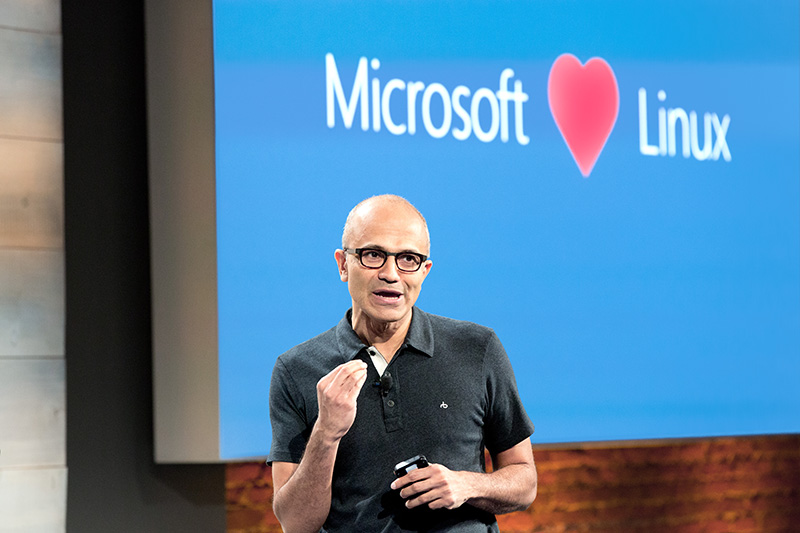
When speaking to the world’s economic elite about AI on the 20th in Davos, Switzerland, Microsoft CEO Satya Nadella, said that “…as tech companies spend billions on artificial intelligence data centers and computer chips, fears of an AI bubble held privately by Wall Street traders and some Big Tech titans are beginning to pop into public view.” His biggest worry is the current state of the AI market, as the AI frenzy has buoyed stock markets for years and driven record-high valuations. However, now Nadella suggests that if AI doesn’t pose more practical uses outside of the tech industry, the economic bubble it exists within might pop.
Although this statement, especially regarding the economic side, is new, Nadella has been sharing similar beliefs about AI since the end of 2025. He has spoken about how he believes AI should be thought of as a “scaffolding for human potential” rather than a substitute.
Microsoft’s AI strategy isn’t to market AI technology as a replacement for workers, but rather as companions for them. Over the last year, Meta, Alphabet, Microsoft, Amazon, and Oracle, have invested around $342 billion invested into AI last year, making AI was responsible for around 1.1% of the USA’s GDP growth last year.
Due to this, Nadella and Microsoft have been preaching about AI diffusion for the past year, as failure to integrate AI into multiple fields instead of hyper-focusing on the technological aspect and allowing it to be perceived as “AI slop” can create an unrest that could cause a disastrous burst of the AI bubble, leading to a massive crash.
Not only that, but Nadella has also spoken about the possibility of AI companies losing permissions to operate if they do not grow past their economic bubble. AI, as it currently stands, is an extremely energy-draining resource; most AI prompts run on “tokens,” which serve as basic units of processing for AI models.
Nadella’s worry is that “…we will quickly lose even the social permission to actually take something like energy, which is a scarce resource, and use it to generate these tokens if these tokens are not improving health outcomes, education outcomes, public sector efficiency, and private sector competitiveness across all sectors.”
Nadella worries about Europe’s new stake in the AI market due to potential energy concerns in the U.S. Since it has no such concerns, Europe could potentially be a competitive adversary for the U.S. He fears this will be the only reason AI companies improve in America but adds that AI companies need to focus on improvement in ways that benefit more of society even without competition, or else they might fizzle out.
Microsoft alone has invested over $88 million in AI just in the past year, so this insight from Nadella shows that AI is currently in a precarious situation, with either a possible end in sight or a revolution incoming.