
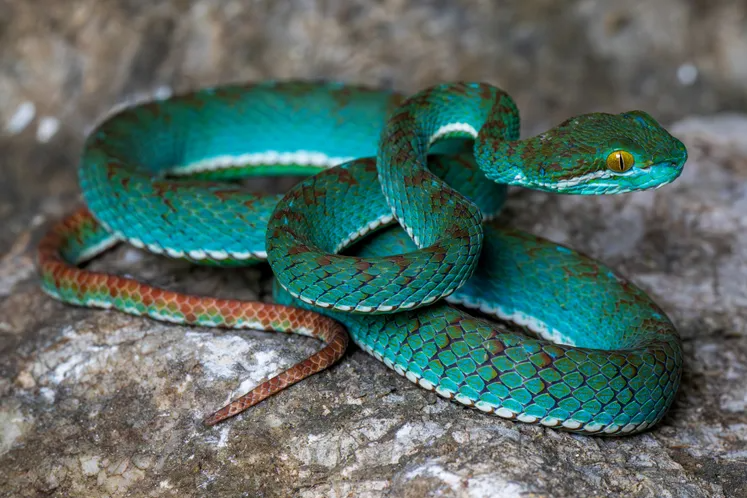
Cambodia has thousands of miles of mostly unexplored limestone caves. These caves are unique ecosystems full of undiscovered species, and a recent survey uncovered several new species, including a turquoise pit viper, a flying snake, several geckos, two micro-snails, and two millipedes. Out of the new species, the viper and three of the gecko species are still being formally characterized and named. The rest have been officially recognized as new species.
The recognitions occurred over the course of a biodiversity survey, which explored 64 caves across 10 hills between November 2023 and July 2025. The final report of the survey was released on Monday, March 23rd. According to Fauna & Flora Cambodia, an organization that led the study alongside the country’s ministry of environment, the explored areas were known for their karst—a term for a landscape created when rocks break down, forming large cave springs, sinking streams, and sinkholes—which often lead to entire hidden caves and harbor entire ecosystems.
Cambodia’s karst formations have been historically understudied, according to the organization, likely due to the immense isolation these habitats faced from self-sustaining while human activity began to spring up around them. “Surrounded by a sea of inhospitable, human-made landscapes, many of these creatures are, in effect, trapped,” said Fauna & Flora. “Today, each of those miniature karst havens contains species that are found nowhere else in the world.”
The discoveries made were greatly exciting for some branches of science. The newly discovered pit viper, for example, was described as a “spectacular new species” in the reports. With their recognizable triangular heads, which signifies they are “highly venomous,” and their ability to “track down their warm-blooded prey using the heat-sensitive pits behind their nostrils,” although one of the uncharacterized species, it is regarded as one of the more exciting finds for the scientific community. Other species like the new flying snake, which, while part of the recognized genus Chrysopelea, is one of the only five recognized flying snake species. Along with the snakes, the reports also detailed excitement over the “cryptically camouflaged leaf-toed geckos” and vividly colored millipedes, which are likely quite poisonous, and were all uncovered during the survey.
These discoveries seem to be precursors of something much larger, however. As these karst landscapes make up around 9% of Cambodia, or roughly 7,722 square miles, and the reports indicate that a large portion of that area is still unexplored. As Pablo Sinovas, lead of the Fauna & Flora team in Cambodia, “There is more exploration to be done,” according to him; when it comes to the vast area of karst caves, science has only “scratched the surface.”