
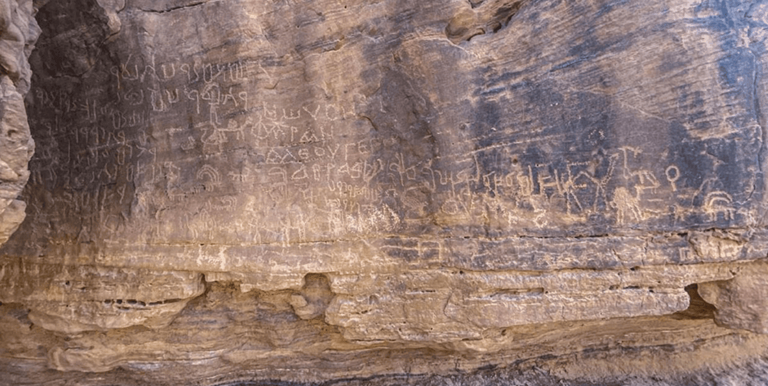
Archaeologists have unearthed ancient rock art in Egypt that could have been a popular rest stop for earlier societies and travelers. The site is located in the south of the Sinai Peninsula where Cairo is in the middle of a megaproject with the goal of drawing mass tourism to the mountain town of Saint Catherine. The rock art depicts hunters as well as two-dimensional shapes. This was found in the southern Sinai Desert and is dated at around 10,000 years ago.
Located near copper and turquoise mines, it likely had a cooling effect on those who were traveling. While there is much speculation and curiosity on this finding, there is still much to be determined especially since it is such a new discovery. Currently, archaeologists are trying to put much of the engravings in context, such as the meanings behind the geometric shapes. But already the discovery has assisted in the understanding of ancient Egyptians and their relations to the environment around them, as they engraved meaningful creations along tall, natural desert walls. The engravings provide further evidence of civilization in this period of time in Egypt. Antiques experts have described the art found as a significant addition to the imagining of various antiques.
The wall art ranges in years of creation but the majority of the carvings date from around the same time period. The shelter is about 330 feet long and 10 feet deep, with a ceiling maxing at 5 feet high.
This discovery “will certainly help us better understand the interactions of the ancient [Egyptians] with the desert environment, and with those people living in and moving through the region,” according to an Egyptology professor at Yale University.